
Although Charles Wilson Peale had been using coal gas to light his museum of oddities in Independence Hall as early as 1816 and the Chestnut Street Theater had gas lighting by 1822, city leaders rejected the idea of leaky gas tanks and were cold to the the idea of a city sponsored gas works in the early 19th century. That was until Samuel Merrick, a fire engine builder and founder of the Franklin Institute decided to get himself elected to council vowing to bring the city into the 19th century. By 1835 the ambitious Merrick had erected a facility at 24th and Chestnut Sts. on the model of London’s Regency Park Gas Works and a year later the ornately detailed facility was producing enough gas to light 2nd Street from South to Vine Sts.
In 1841 the city assumed control of the quasi-private Works and chief engineer John Cresson soon realized that the 1.68 million cubic feet capacity of the 11 gasholders were still insufficient to supply the growing city. Cresson was a believer in the future of gas lighting and in 1861 he deemed experiments with an “electric lite” far more absurd than practicable gas technology. By 1851 City councils agreed to expand the works and purchased land at Point Breeze for this purpose. Cresson saw that the new facilities were built in the rarely-used Gothic Revival style with the gray granite retort house sporting arched lancet windows and buttresses.
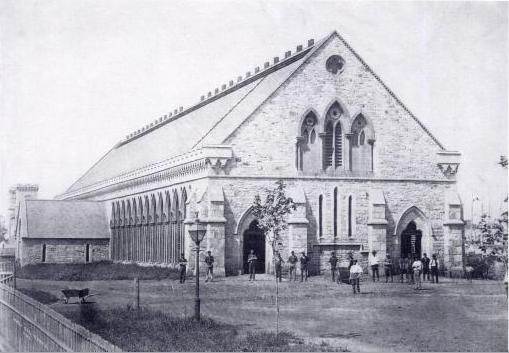
[What Gothic Revival style meant in an industrial context has not been fully explored. It may have had something to do with 19th elites’ nostalgia for the peace and stability of medieval Christian Europe prompted by rising antagonism from immigrant workers. Or it could have been a style choice devoid of symbolism. I would love to know more explanations for the use of this idiom in industrial settings. See Edgar Jones’ Industrial Architecture in Britain: 1750-1939]


[Point Breeze Gas Works: 1895/present]
According to Buried Past: An Archaeological History of Philadelphia, there was more to Cresson’s design than nostalgia or good looks; it enabled both the efficient movement of materials and ventilation ensured the comfort of those shoveling coal in the blistering heat of the retorts. The facility continued to produce gas until after World War II when natural gas and the electric light ended the need for gas from coal.
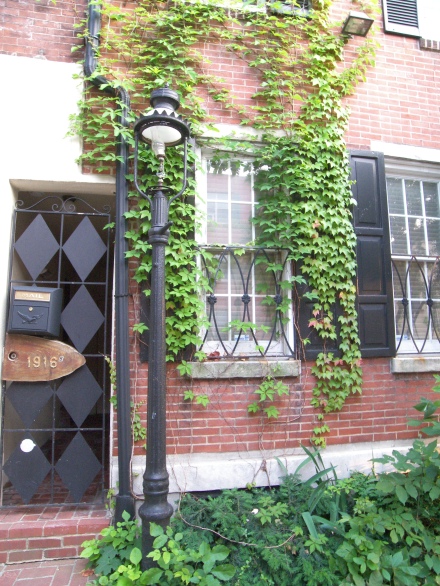
Yet while nothing remains of the 19th c. Point Breeze site, there are still vestiges of street lamps built by the Penn Gas Globe Light Company of Philadelphia at two points on Lombard Street between 22nd and 19th Streets. Though the Penn Gas Globe Light Company of Connecticut is still in existence, these lamps are clearly marked “Phila.” and are original. The one at 1916 Lombard still has the mechanism for introducing vaporized gas to the flame. [Here is the original patent.] The one at 2220 Lombard appears to have been modified for electric bulbs. Other lamps exist on Pine Street. If anyone knows of more, I’m doing an informal survey so let me know.


 The Necessity for Ruins
I am writing a memoir of my childhood in Oak Lane, Germantown and Mt. Airy from 1941. For a while we lived on East Wister Street, and I am fairly sure there were still gas street lights there in the mid-1940s. Would you know whether this is possible?
Thanks for your informative website.
Did you ever find out when gas lighting was replaced by electric
lamp bulb? We are anxious to know when lamp lighters were no longer needed in Philadelphia.
Please respond to : lmstetz@verizon.net
Thanks
To Marion Blackmer – my mother is now 92 and recently wrote in her column a reminiscence of the gas street lamps in Mt. Airy and Germantown where she was raised. Born in 1916 She graduated from Gratz High in 1937 – she particularly remembers a lamplighter named Tony, and getting in trouble for hanging from one of the cross pieces on the lamps which resulted in some neighbor boys seeing her underwear – shocking! So I wold not be surprised to know the fixtures were still there only 15 years or so after her childhood.
I have one of these lamps and am in the process of restoration. Would like to find a manual which describes the components and their operation.
Interesting site; I remember living on “J” street as a small child about five or six years old and watching a man come by every night and light the Gas Street lamps. The older boys woul put me om their shoulder to turn the lamps off.
I asked my older sister if she rememberd Gas Street lights too and she said yes with out hesitation and my little sister said the same thing . Oh how i wish we could all go back to the old days.
Joe Mclaughlin, I grew up on J st., and new an Eddie Mclaughlin, are you related.
Interesting site; I remember living on “J” street as a small child about five or six years old and watching a man come by every night and light the Gas Street lamps. The older boys would put me om their shoulder to turn the lamps off.
I asked my older sister if she remembered Gas Street lights too and she said yes with out hesitation and my little sister said the same thing . Oh how i wish we could all go back to the old days.
I remember gas lights on Napa st in Strawberry Mansion till 1955. One was outside my house on 2426 N Napa 1/2 a block south of Lehigh.
I grew up in East Mt Airy, at the corner of Chew Ave and Sedgewick St. I remember when I was a small child seeing several gaslights along Sedgewick between Chew and Boyer that were turned on every evening and off every morning by a man using a small ladder and a long rod with a sparker on the end. Lighting was discontinued in the early 50s but the lampposts were not removed for several years. My brothers used to hang from the crosspieces too, but I was too small to shimmy up the pole
While a student at Temple from 1955-1959, I frequently visited a friend who lived on Harrison St. in Frankford. His block was lit by gas lights.
Wow! I grew up on Harrison St, where I lived till I was graduated from North Catholic and enlisted in the Air Force in 1955. I vividly recall a Lamplighter servicing a lamp in a large back yard area between Mulberry and Charles Sts. Every evening. I cannot recall when he no longer appeared. I think he also serviced other lamps in the neighborhood, but can recall where. They were great days! Ted McFadden.
I grew up in South Philly, at 1823 S. 5th Street. I recall a single gas lamp on Little Sigel Street just east of 5th that was lit by a lamplighter . It’s the only one in the neighborhood that I remember. It was in operation until at least the early 1950’s.
I lived on the 5500 block of Malcolm Street in West Philadelphia when I was small from 1955 to 1963. I remember gas street lights. We used to climb the poles and turn them off. Did anyone else live in that area and remember this?
i have a gas light and i am intrested in selling it but need to know more about the coast of what i have can you help me ?
Does anyone know where I can buy some globes for the gas street lights? My globe isn’t like the one in the picture but the light looks alot like it. My globe covers the entire base.
i have some globes and poles put it short i have the gas streetlights for sale
I OWN A STREET LIGHT AND AM IN NEED OF A NEW GLOBE. MINE HAS A SMALL CHIP AT THE BOTTOM. DO U STILL HAVE PARTS FOE SALE?
Hi Anthony I do have globes for sale and parts my phone number 609-287-8404
how much
I found one of these in my back yard…,
I am looking for the globe–white and clear parts and would happily buy from you if you still have it.
I have an original Penn Gas Globe Light “Phila.” ! It was purchased and moved from Philadelphia years ago to serve as my entry lamp post in York PA. Nice article and thanks!
I grew up in Roxborough/Manayunk area. I tell people I remember as a child seeing the gas lamps around the corner on Pensdale Street,when I was a child. I was born in 1943. Wife feels I’m looney. Ed Dziewit
i
I recall three gas street lamps on Ainslie Street in East Falls between Vaux and Conrad in the early 1950s. They disappeared along with the cobblestone street about the same time.
I have one of the posts in the driveway of my home in Pequea, PA. It’s now electric and the light fixture was destroyed by a recent storm but I plan to repaint the post and replace the light fixture soon. Nice article. Thanks for posting.
Lived on Mutter St. 1800 block North in 1947. We had gas street lamps and I remember
the “Olde Lamp Lighter”. Whenever I hear the song I can picture the man with his wooden
ladder.
My wife’s grandfather worked for the Philadelphia Gas Co. for years and I would love to purchase an old street gas lamp. If anyone knows of someone who may be selling one please let me know. Thanks
jwa4pmr@aol.com
Try contacting any of several demolition companys in the area. They know their value
and try to save them.
Thanks for finally writing about >Remnants of Philadelphia’s Gas
Network | NFR <Liked it!
I am 80 yrs old and I remember a Lamplighters on the 3400 block o E Street in Kensington ,it had to be in the early 40’s
My Great-Great Grandfather, Antone Hosephros was a lamplighter in Manayunk/Roxborough at the turn of the century. My mother, Helen Hosephros Davis said she remembers as a child – watching him from her bedroom window on Ridge Avenue come up the hill and light the lamp in front of their home every night.
I lived near Amber & Stella Sts. In Kensington. The lamplighter came down Stella St. every night with his ladder and lit the gas light. They were positively the Good (great) old days. You could even leave your door unlockef. Remember playing under the fire hydrant.
I lived the first few years of my life on the 4000 block of Fairhill st in N. Philadelphia (1948-1956). We had gas street lamps that produced the most wonderful yellowish light that would filter through the trees. I hated the day when the street lighting was electrified.
There is a partial gas lamp post located at 10th and Reed. It’s of the Penn Gas Globe
variety. About 5 feet tall.
I was born and lived at 2217 South Bancroft Street in South Philly until 1950. There were three gas lamps on our street during that period. I am also writing a memoir of my time on that street. 1937 to 1950. I now live on San Juan Island, Washington.
Birdstudio Inc. In Germantown restores and sells these original gas lamps.
I have access to couple of these and looking to gather more info on them. There are several variations of this. There is also a longer skinnier type akin to a flag pole. Some says phila, others penna globe. Some has no inscriptions on them. These were maintained and repaired over the years, you can even see where the have cracked, but grazed and reinforced. Definitely stood the test of time. I will like to have more literature on these. It is a piece of history